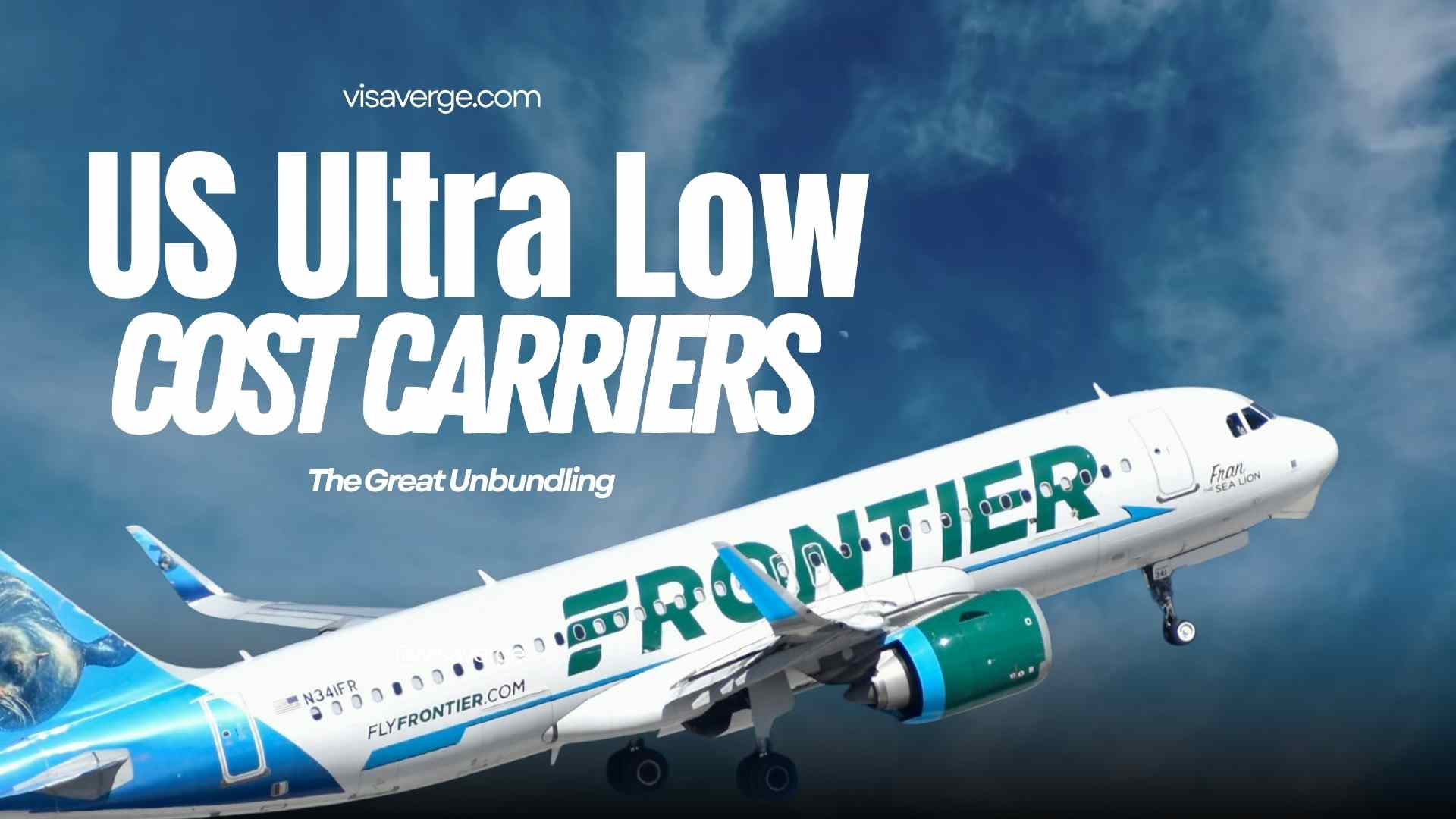
US Ultra-Low-Cost Carriers:
The Great Unbundling
A comprehensive analysis of America’s budget airline sector—from Spirit’s Chapter 11 collapse to Frontier’s strategic pivot, and the rise of next-generation carriers reshaping how Americans fly.
- Market Bifurcation: The US ULCC sector has split into “Survivors” (Spirit in bankruptcy, Frontier pivoting) and “Innovators” (Breeze, Avelo) pursuing differentiated strategies.
- Ancillary Dominance: Frontier leads globally with 62% of revenue from non-ticket sources—bags, seats, subscriptions—making fares nearly irrelevant to profitability.
- Spirit’s Collapse: A “perfect storm” of Pratt & Whitney engine groundings, blocked JetBlue merger, and cost convergence with legacy carriers drove a $1.1B operating loss and Chapter 11 filing.
- The New Model: Next-generation ULCCs like Breeze and Avelo reject the “cattle car” aesthetic for premium options and secondary airports, achieving profitability without hub competition.
The United States commercial aviation sector has undergone rigorous stratification since deregulation. While network carriers evolved through consolidation, a parallel disruption occurred at the lower end—the “Ultra-Low-Cost Carrier” model that has democratized air travel while creating a volatile, high-stakes operational environment.
The distinction between a Low-Cost Carrier (LCC) like Southwest Airlines and a true ULCC is foundational. Southwest retains bundled attributes—free checked bags, flexible change policies—while ULCCs like Spirit and Frontier operate on a “bare fare” philosophy where the ticket covers transportation only. Everything else, from carry-on luggage to printed boarding passes, is monetized as ancillary products.
The Ancillary Revolution
The most significant divergence between ULCCs and traditional airlines lies in their revenue composition. For legacy carriers, the ticket price is the primary revenue driver. For a ULCC, the ticket is often a loss leader designed to capture customers into an ecosystem of fees.
2024 Ancillary Revenue Rankings
| Rank | Airline | Ancillary Share | Primary Revenue Drivers |
|---|---|---|---|
| #1 | Frontier Airlines | 62.0% | Baggage, Seat Selection, “UpFront Plus”, Subscriptions |
| #2 | Spirit Airlines | 58.7% | Baggage (Carry-on/Checked), “Big Front Seat”, Boarding Pass Fees |
| #3 | Breeze Airways | 54.0% | Bundled Fares (Nicer/Nicest), First Class Upgrades, Pet Fees |
| #4 | Allegiant Air | 52.9% | Third-party Commissions (Hotels/Cars), Cobranded Credit Card |
| #5 | Sun Country | ~25-30% | Hybrid model dilutes percentage (Charter/Cargo revenue) |
For Frontier Airlines, nearly two-thirds of revenue comes from products other than the flight itself. This creates unique economic resilience: even if base fares collapse due to competition, the airline retains a high floor of revenue per passenger—averaging over $68 in ancillaries per passenger.
The Mechanics of Monetization
Fee generation has evolved far beyond simple bag charges. Dynamic baggage pricing increases fees as departure approaches—a bag purchased at booking might cost $50, while the same bag at the gate exceeds $99. Seat segmentation monetizes cabin real estate through products like Spirit’s “Big Front Seat” and Frontier’s “UpFront Plus” (blocked middle seat) without true business class operational complexity.
Subscription models like Frontier’s “Discount Den” and Spirit’s “Saver$ Club” charge annual fees for fare discounts, locking in customer loyalty and generating recurring high-margin revenue.
The Incumbents: Divergent Paths
The US ULCC sector’s narrative is defined by the starkly contrasting fortunes of its two largest players: Spirit Airlines and Frontier Airlines. Both carriers share common lineage through Indigo Partners and Bill Franke’s strategic direction, yet their 2025 realities couldn’t be more different.
Spirit Airlines
Spirit, the pioneer of the US ULCC model, spent 2010-2020 as one of the world’s most profitable airlines. A “perfect storm” precipitated its collapse: Pratt & Whitney engine defects grounded ~20% of its fleet for mandatory inspections, the DOJ blocked the JetBlue merger on antitrust grounds, and cost convergence with legacy carriers eroded Spirit’s historic CASM advantage.
The November 2024 Chapter 11 filing involved $100M in DIP financing, rejection of 87 aircraft leases, and exit from numerous markets including Albuquerque, Boise, and Birmingham—a 25% capacity reduction year-over-year.
Frontier Airlines
While Spirit faltered, Frontier executed a successful strategic pivot returning to profitability after four years of losses. The “New Frontier” strategy fundamentally rethought the ULCC network model.
The “Out-and-Back” model ensures aircraft and crews start and end their day at the same base, eliminating expensive overnight accommodations and generating $100M in annual cost savings. “UpFront Plus” premium merchandising captures small-business travelers with blocked middle seats, significantly boosting unit revenue without capital expense.
The Niche Specialists
Beyond the national battles of Spirit and Frontier, two carriers have cultivated specialized business models insulating them from direct legacy carrier competition.
Allegiant Air
Allegiant views itself as a “travel company” rather than an airline, connecting underserved small cities (Toledo, Sanford) directly to leisure destinations. The “Low Utilization” anomaly defies standard economics—parking planes on low-demand days (Tuesdays/Wednesdays) and flying intensely during peaks prevents flying empty just to keep aircraft moving.
The Sunseeker Resort vertical integration attempt became a financial albatross with construction delays and cost overruns, resulting in a massive Q4 2024 impairment. However, the core airline business remained healthy with 7.7% adjusted operating margin.
Sun Country Airlines
Minneapolis-based Sun Country operates arguably the sector’s most resilient model using a single 737-800 fleet across three distinct business lines: scheduled leisure service, charter operations (DoD and NCAA teams), and Amazon Prime Air cargo under a strategic partnership operating 12 converted freighters.
This “three-legged stool” creates counter-cyclical stability. Charter contracts are long-term and insulated from fuel fluctuations. Over 28% of revenue comes from non-scheduled service, protecting against the fare volatility that crushed Spirit.
The New Entrants: ULCC 2.0
The post-pandemic landscape birthed two carriers representing “ULCC 2.0″—low costs with a focus on “humane” service and secondary airports.
Breeze Airways
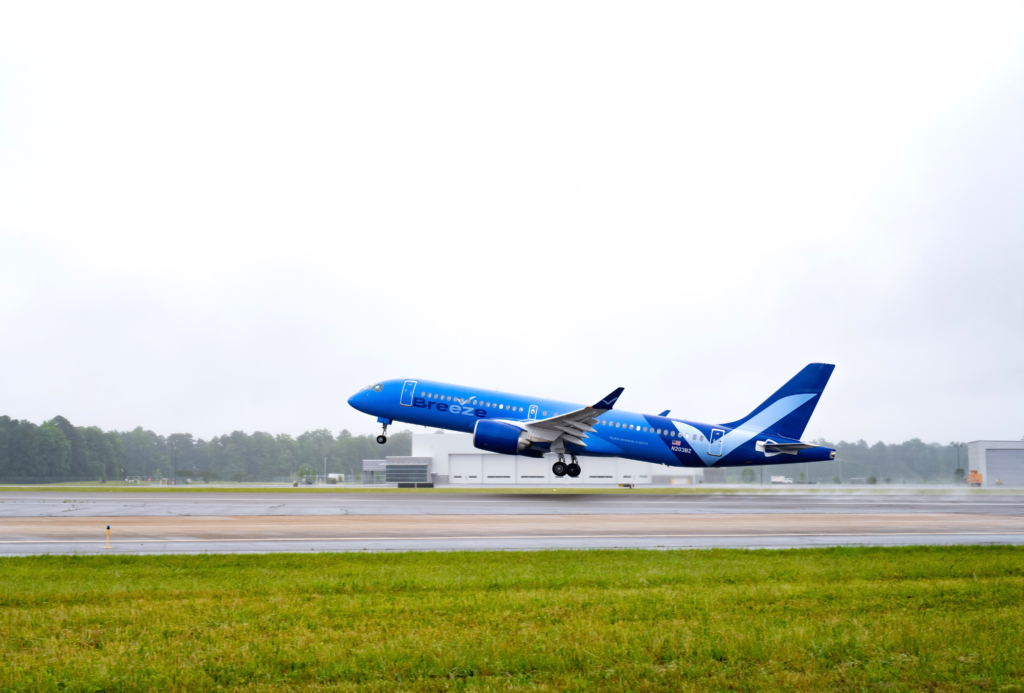
Founded by JetBlue/Azul creator David Neeleman, Breeze distinguishes itself with “Nice, Nicer, Nicest” product segmentation avoiding adversarial “gotcha” fees. The A220-300 fleet enables “long and thin” routes—connecting city pairs like Providence to Los Angeles with ~137 seats rather than 180.
The “Breeze Ascent” premium cabin features 2×2 recliner seats with 39″ pitch and high-speed WiFi, capturing high-yield leisure traffic that Spirit and Frontier cannot. Breeze achieved its first profitable quarter in Q4 2024, generating over $200 million in quarterly revenue.
Avelo Airlines
Founded by former Allegiant executive Andrew Levy, Avelo applies the Allegiant model to different geographies—igniting service at dormant secondary airports near major metros (New Haven instead of JFK; Wilmington instead of Philadelphia).
Operating used 737-700/800 aircraft with low capital costs enables profitable low-frequency schedules. In late 2024, Avelo strategically exited its Burbank base to consolidate East Coast operations around New Haven—achieving profitability within four years of launch.
Hard Product Comparison
The physical product and operational metrics are final differentiators for consumer choice. Seat pitch (legroom) varies significantly across the ULCC spectrum.
| Carrier | Aircraft | Standard Pitch | Premium Option | Premium Pitch |
|---|---|---|---|---|
| Spirit | A320/A321 | 28″ | Big Front Seat | 36″ |
| Frontier | A320/A321 | 28-29″ | UpFront Plus | 36-38″ (Stretch) |
| Allegiant | 737/A320 | 30″ | Allegiant Extra | 34″ |
| Breeze | A220-300 | 30-31″ | Breeze Ascent | 39″ |
| Avelo | 737-800 | 29″ | Extra Legroom | 32-35″ |
| Sun Country | 737-800 | 29-30″ | Best | 34″ |
Market Outlook: Winners & Losers
The 2025 landscape confirms the “growth at all costs” era of US ULCCs is over. The market has bifurcated into distinct categories with clear winners and losers emerging.
-
✈️
Frontier Airlines
Pivoted network model, leading ancillary revenue, returned to profitability
-
🌤️
Breeze Airways
Premium-lite positioning, A220 efficiency, first profitable quarter achieved
-
☀️
Sun Country
Diversified revenue streams protect against passenger demand volatility
-
⚠️
Spirit Airlines
Chapter 11 restructuring, 50% fleet reduction, lost competitive moat
-
🏨
Allegiant (Resort)
Sunseeker debacle, $322M impairment—airline core remains healthy
-
📊
Traditional ULCC Model
Cost convergence with legacy Basic Economy eroding price advantage
The ULCC sector remains vital as the primary governor on legacy carrier pricing power. However, the definition of “Ultra-Low-Cost” is evolving—it no longer simply means the cheapest seat. It now encompasses sophisticated unbundled menus, hybrid business models, and operational agility. The winners of the next decade won’t be airlines with the lowest fares, but those with the most resilient cost structures and intelligent monetization of the passenger wallet.