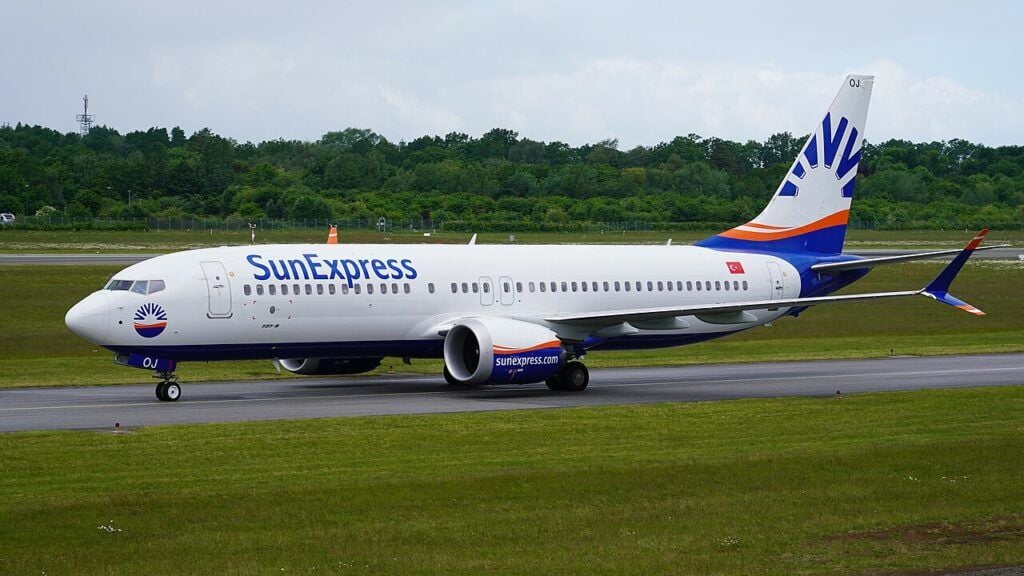
- A SunExpress Boeing 737 suffered a gear collapse while taxiing at Antalya Airport on Friday.
- All 175 passengers and six crew evacuated safely via stairs without any reported injuries.
- The airline quickly deployed a replacement aircraft to complete the flight to its destination.
(ANTALYA AIRPORT, TURKEY) — A taxiway mishap rarely makes you rethink an airline, but SunExpress handled this one the way you’d want any carrier to: the SunExpress Boeing 737-800 involved in Friday’s incident never left the ground, everyone got off safely, and the airline quickly found a replacement jet to finish the trip.
This review isn’t about seatback screens or espresso martinis. It’s about the real-world “product” you buy when things don’t go to plan: crew communication, airport response, and how painful (or painless) your rebooking day becomes. And yes, I’ll still cover the usual cabin basics, because your next SunExpress flight will almost certainly be on the same Boeing 737-800 setup.
Quick verdict: Is SunExpress worth booking after this?
If you’re flying domestically in Turkey or to nearby leisure markets, SunExpress remains a reasonable pick when the price is right. The airline’s core product on the 737-800 is straightforward and no-frills. It competes most closely with Pegasus on value, and it sits a step below Turkish Airlines on onboard comfort.
What stood out here was the outcome and the response. A left main landing gear collapse while taxiing looks dramatic, but the lower speed matters. Everyone onboard was able to deplane without injuries. That’s the single most important measure of “did the system work.”
If you’re a nervous flyer, this incident may stick in your head. If you’re a practical traveler, the more useful takeaway is this: taxi incidents can still create big delays and missed connections, so your booking choices should assume disruption is possible.
Incident overview: what we know, and why it matters
On Friday, February 13, 2026, a SunExpress Boeing 737-800 (registration TC-SOB) suffered a left main landing gear collapse while taxiing for departure at Antalya Airport. It was on a domestic sector and still in the departure phase, not the takeoff roll.
There were 175 passengers and six crew members onboard. No one was injured. The aircraft was removed from service for inspection, which is standard after any structural event.
For travelers, two things matter most:
- A taxiway event can still cancel your day, even if it’s not a high-speed accident.
- The best-case safety outcome can still produce the worst-case schedule ripple.
What happened (in plain English)
A main landing gear is the aircraft’s primary set of wheels under the wings. On a 737-800, there are two main gear assemblies and one nose gear. When the left main landing gear collapse occurred, it happened without warning during taxi.
From a passenger’s perspective, a taxi-phase gear failure typically feels like:
- A sudden drop or lurch to one side.
- A harsh jolt through the cabin floor.
- A grinding or scraping sound as metal contacts the pavement.
In this case, the aircraft rolled to the left and came to rest on the left engine nacelle. That’s the engine’s outer housing. The fuselage tilt can look severe from inside, because the cabin floor is no longer level.
It’s also worth separating “taxi” from “takeoff” or “landing.” Taxi speeds are low, and forces are lower. That usually reduces injury risk. It also gives crews and airport teams more time to respond in a controlled way.
Evacuation and response: why stairs beat slides here
Airport rescue and firefighting teams (ARFF) responded within minutes and secured the area around the aircraft. That quick perimeter control is a bigger deal than most travelers realize. It reduces fire risk, keeps vehicles clear, and creates a safe path for deplaning.
SunExpress and the airport opted for ground stairs instead of emergency slides. That’s often the right call when conditions allow.
Emergency slides can cause injuries, especially on uneven ground or when the aircraft is tilted. A slide deployment can also introduce new hazards. If there’s no fire, no smoke, and the aircraft is stable, crews will often choose a controlled deplaning.
Passengers commonly report a jolt and grinding noises in gear-collapse events. That sensory shock can trigger panic, even when the aircraft is no longer moving. What you should expect immediately after an event like this is fairly consistent across airlines:
- The aircraft stops and the crew makes an announcement.
- The crew checks for hazards, including smoke, fuel odor, or visible fire.
- ARFF positions near the aircraft.
- Deplaning happens in stages, often door-by-door, based on the aircraft’s tilt.
A controlled deplaning is slower than slides. It’s also usually safer when time is on your side.
⚠️ Heads Up: If you’re near an exit row in any disruption, listen first. Opening a door the wrong way on a tilted aircraft can make things worse fast.
Airline communication and recovery: what to do as a passenger
SunExpress described the event as a technical issue involving the landing gear strut during taxi and said passengers disembarked safely. The aircraft was taken out of operation for technical inspection.
That last part matters for your future travel. An aircraft pulled for inspection isn’t coming back quickly. Even if the airline has spare planes, a sudden aircraft swap can cascade into later flights.
SunExpress arranged a replacement Boeing 737-800 to operate the service. Passengers reached their destination later that day. From a traveler standpoint, the more useful question is what you should do the moment you realize your flight is becoming “a situation.”
Here’s the practical playbook that works on almost any airline:
- Get rebooked first, then sort everything else. Seats vanish quickly.
- Ask for all available routing options, not just the next nonstop.
- If you’re traveling onward, ask to be protected on the fastest connection.
- Request meal or hotel assistance if the delay forces a long wait or overnight.
- Ask for a written disruption confirmation for insurance or employer records.
Keep your receipts. Take a screenshot of the new itinerary. And if you paid with a card that has trip delay coverage, read the benefit rules before you leave the airport.
The cabin “review” angle: what a SunExpress 737-800 is like on a normal day
Most travelers book SunExpress for price and schedules, not luxury. On a typical SunExpress Boeing 737-800, you should expect a standard short-haul layout with slimline seats and a tight-to-average economy experience.
Seat comfort: pitch, width, and what it feels like
On 737-800 aircraft across Europe and the Middle East, economy seating is commonly in the ballpark of:
- Seat pitch: about 29–31 inches on many rows.
- Seat width: around 17 inches (a 737 reality, not a SunExpress-specific problem).
The lived experience depends on two things: your row and how full the flight is. If you’re taller, knee clearance is the main issue. The seat cushion and recline tend to be modest.
If you can pay a bit more, look for:
- Extra-legroom rows (often sold as preferred seating).
- A seat that avoids heavy traffic near galleys and lavatories.
Power outlets: don’t assume you’ll have them
On many leisure-focused 737-800s, in-seat power is limited or not available in standard economy. Plan like you’ll be on battery.
If your phone is also your boarding pass, entertainment, and translator, bring:
- A charged power bank.
- A short cable you can use one-handed in a tight seat.
Overhead bins and carry-ons
737-800 overhead space is workable, but boarding order matters. If your fare includes a carry-on, board as early as you can. If not, price out whether a paid cabin bag is worth it. Gate-checking can slow your exit, which matters during disruptions.
Food and service: buy-on-board expectations
SunExpress service tends to be efficient and functional on short sectors. Think buy-on-board snacks and drinks, with selection depending on route and time of day.
Two practical tips that improve the experience:
- Eat before you board if you’re on a tight connection or a late flight.
- Carry a refillable water bottle and fill it airside.
If you have dietary needs, don’t count on specialty meals unless your booking explicitly offers them. On short-haul leisure networks, catering can be simple.
Entertainment: bring your own screen plan
On many 737-800 flights in this category, seatback screens aren’t part of the deal. Some airlines offer streaming to your device, but consistency varies by aircraft and route.
Plan for offline:
- Download a playlist and a podcast.
- Save maps for your destination.
- Keep your hotel confirmation accessible without data.
If you’re traveling with kids, the lack of seatback IFE changes everything. Pack headphones, a charger, and one non-screen activity.
Amenities and onboard basics
Call it the “European low-cost adjacent” standard:
- Lavatories are compact.
- Boarding can be by stairs at some airports.
- Cabin announcements can be brief and businesslike.
If you care about comfort more than cost, your best “amenity” is often your seat selection and a smart personal item.
How SunExpress compares: the alternatives from Turkey
SunExpress sits in a busy market. Your best alternative depends on whether you want full service, the lowest fare, or the best on-time backup options.
Here’s how the experience usually stacks up for a typical short-haul flight:
| Category | SunExpress (737-800) | Turkish Airlines (domestic) | Pegasus (737/A320 family) | AJet / AnadoluJet (varies) |
|---|---|---|---|---|
| Fare style | Value-focused, add-ons common | More inclusive bundles | Ultra price-driven | Middle-ground, route dependent |
| Seat comfort | Standard 737 economy | Often similar, sometimes better bundles | Similar tight economy | Mixed by aircraft |
| Food | Often buy-on-board | More likely included on some fares | Buy-on-board | Mixed |
| Power | Often limited | More likely on some aircraft | Often limited | Mixed |
| Rebooking options | Good where SunExpress has frequency | Strong network depth | Good on key routes | Improving, depends on base |
| Best for | Leisure trips, price-first | Comfort and network | Lowest fares | Domestic coverage, deals |
The competitive edge for Turkish Airlines is network depth and passenger protections that feel smoother when things go sideways. The edge for Pegasus is price. SunExpress typically wins when it splits the difference and the schedule fits your trip.
Miles and points: what you should expect
SunExpress isn’t part of a major global alliance. That changes the “earn and burn” math.
In practice:
- Some SunExpress tickets may be eligible to earn miles through partner arrangements or codeshares, depending on how the ticket is issued.
- If your goal is elite status, make sure the fare you’re buying actually earns credit where you need it.
If you’re chasing status, compare the all-in price of a SunExpress ticket against a Turkish Airlines ticket that earns more reliably in Miles&Smiles. The cheapest fare can be expensive if it earns nothing.
Investigation: what gets examined after a taxi gear-collapse
Turkey’s Directorate General of Civil Aviation opened a formal investigation. That’s the normal path for an event involving structural damage.
In a taxi gear-collapse case, investigators typically look at:
- The landing gear assembly and attachment structure.
- Hydraulic components that control gear position and braking behavior.
- Maintenance records and inspection intervals.
- Recent flight history, including earlier segments that day.
- Physical evidence, including fracture surfaces and component wear.
The aircraft’s in-service age provides context, but it isn’t a verdict. Parts have lifetimes, and aircraft undergo routine checks designed to catch issues early. Investigators often start with possible failure modes, then narrow down once lab analysis and records review are complete.
For travelers, the most useful expectation is timing. Investigations move carefully. Initial facts can arrive quickly, but confirmed root cause takes longer.
Who should book this?
SunExpress is still a sensible booking in three common situations:
- You’re price-first and flying a short route where timing is flexible.
- You’re traveling light, can board early, and don’t need lounge-style perks.
- You’re going point-to-point, with no tight connection to protect.
Consider paying more for an alternative when:
- You’re connecting onward, especially internationally, and a missed connection would be costly.
- You need miles or status credit on a specific program and can’t confirm earning.
- You want maximum rebooking options, which usually means the biggest network on your route.
If you’re flying out of Antalya soon, build a little buffer into your day. Pick flights earlier than you “need,” and keep your receipts organized in case a routine trip turns into an airport marathon.