

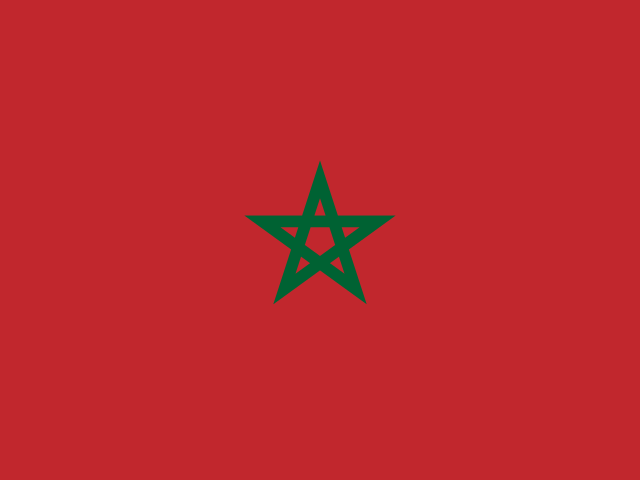
Customs
Africa
Morocco Customs Regulations
Import & export rules, duty-free allowances, prohibited items, and traveler health advisory
200 cigs
Tobacco allowance
1 litre
Alcohol allowance
← ALL COUNTRIES
Import Regulations
- Clothes for personal use.
- Tobacco (200 cigarettes, 100 cigarillos, 25 cigars, or 250 grams of assortments).
- Alcoholic drinks ( 1 liter bottle).
- Jewellery, perfumes (150 ml) and toilet water ( 250 ml).
- Souvenirs, presents whose value should not exceed 2000 DH.
- Camera, camcorder, binoculars or CD player.
- Tape recorder, radio, TV, camera, typewriter or calculator, portable computer, mobile phone.
- Sport fittings
- Musical instrument
- Bicycle, tandem, bicycle having an auxiliary motor.
- Non-residents must re-export these items at the end of their stay.
- Arms and ammunition.
- Drugs
- Books, printed matter, audio and video cassettes and any immoral items liable to cause a breach of the peace.
- Vegetable products: phytosanitary certificate.
- Endangered species of wild fauna and flora (Washington Convention): CITES certificate, delivered by the Directorate of Waters and Forests.
- Hunting arms and their ammunition: authorization of the National Security Services required.
- Medicines:
- In small quantities for personal use: the signature of an affidavit available at the customs offices, accompanied with medical proof (medical certificate, prescription, etc), required.
- For purposes other than personal use: the authorization of the Ministry of Health required.
- The Moroccan Administration allows the temporary admission of non-residents’ vehicles for a period of 3 months. However, these vehicles should be used for tourism only (and not as a means for transporting goods having a commercial character).
- To respond to some visitors’ desire to spend Christmas in Morocco, it was decided that visitors who have already benefited from the temporary admission regime during the current year be allowed to bring in their vehicles starting from 20, December of the same year. However, the second period of admission shall be deducted from the following year.
- Morocco’s national currency is the Dirham (DH). The Dirham is divided into 100 centimes. It is strictly forbidden to import or export the Dirham.
- Non-resident foreigners may freely exchange the imported currency at the banks or at the authorized institutions (hotels, bazaars, etc).
- If they exchange their currency, they should keep the exchange slip. This document may be useful for an eventual exchange of Dirhams.
- If they wish to re-export all or part of the currency they import, they should sign, at their entry, a declaration of the importation of means of payment.
Export Regulations
- Without formalities:
- Products of Moroccan origin (craft industry, etc) acquired locally. No value has been fixed.
- Souvenirs.
- Ornamental, fossiliferous or semi-precious stones (should not exceed dozens).
- With formalities:
- Objets d’art and antiques: authorization of the Ministry of Culture required.
- No information available
- No information available
Health & Security
Basic health information for travelers to Morocco
Basic security information for travelers to Morocco
🩺 Basic Health Information for Travelers to Morocco
- Vaccination against Yellow Fever is required if arriving within 6 days after leaving or transiting countries with infected areas. Exempt from Yellow Fever vaccination are those not leaving the airport in the infected countries concerned.
- No certificate of vaccination is required for travelers coming from Europe or America.
- Anti-cholera vaccine may be required for travelers coming from afflicted zones.
- Anti-malaria vaccine is not necessary.
🛡 Basic Security Information for Travelers to Morocco
- Owing to the extreme risk of terrorism and general acts of violence, travel to Casablanca and Marrakech is not advised. All travellers should be aware of the global risk of indiscriminate terrorist attacks, which could be against civilian targets, including places frequented by foreigners. Travellers should also be aware that there is a threat of kidnapping in the immediate and wider regions and particular care should be taken in remote regions and border areas.
- Local road conditions are considered poor throughout the country and car related accidents are common. Travellers should exercise considerable caution at all times and avoid driving down poorly lit and maintained roads late at night.
Contact Information
For further assistance please contact the Moroccan Customs authorities directly. They will provide the latest information about customs regulations and export-import procedures.
Telephone
+212537677501 Ext. 08
Official Website